A nurse and a teacher chat about medical training. An actor avoids the paparazzi. A veterinarian explains why they need patience to do their job well. A politician in a suit works the crowd.
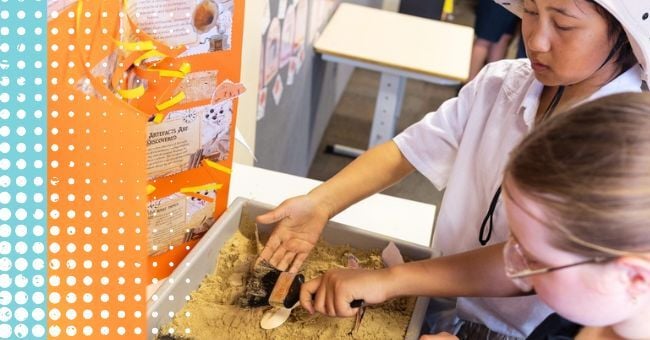
Someone crows with delight as they gently brush sand away from an artefact, watched by the paleontologist.
An aspiring diesel mechanic shows why he needs dexterity -- and he practises by doing a particularly tricky maze puzzle that builds his fine motor skills.
This is careers education, primary school style, and it's running hot at St Martins Lutheran College, Mount Gambier.
The buzz in the room is loud and happy, and apparently it lasted for days! As Future Pathways Leader and Teacher, Linda Polomka wrote,
'Students have been buzzing about the expo all week.'

Trying out, finding out
Modern careers education is about moments of discovery, especially in the primary years.
The BECOME program supports younger students to play out some of their ideas, wishes, strengths and interests. To build a possible vision for their own specific imaginings for the future and try it on for size.
For many students, it's really important they are seen and heard, as they explore and articulate possible ideas about who ‘future me’ might be and try them on for size. No pressure if that idea changes!
This experience can have positive effects at a personal level and a school level. Students feel known and teachers get to know their students in a new way. In this cohort at St Martins, before the BECOME program 32% of students felt a teacher or adult knew their ideas for their future, and post-program this has increased to 83%.
Here's an extract from one of the year 5 students' project:
'I want to be an actor when I am older. It sounds fun and I would meet new people. Actors act in movies, TV shows and lots of other things and I would want to do that because I want to be known for something.
This student's thoughts about their motivations are up front and centre: Why am I interested in this career?
But BECOME's Flipped Careers ExpoTM goes much further. In their project, students devise a Killer Question and a test to learn something about that career and themselves when they reflect on the results.
Killer Question: Is being famous actually a good thing?
They've articulated an idea or an assumption about being an actor, and they have devised a way to test it out:
I chose this question because if actors get famous they don't get a lot of personal time because they get swarmed by regular people, photographers and the media. I would like to know if this is fun or annoying.
Good thinking! They did their experiment -- and what did they think?
I didn't really like my experiment because the younger students got a bit too excited and mobbed me. I didn't like being mobbed. I don't really think that's what it is like being famous but if it is I might have some second thoughts...
Reflective maturity right there. Rather than choosing an idea and sticking to it like glue, they realise they need to think through all aspects of their life and career opptions.
Maybe there's another way to be recognised for your skills without being followed by the paparazzi?
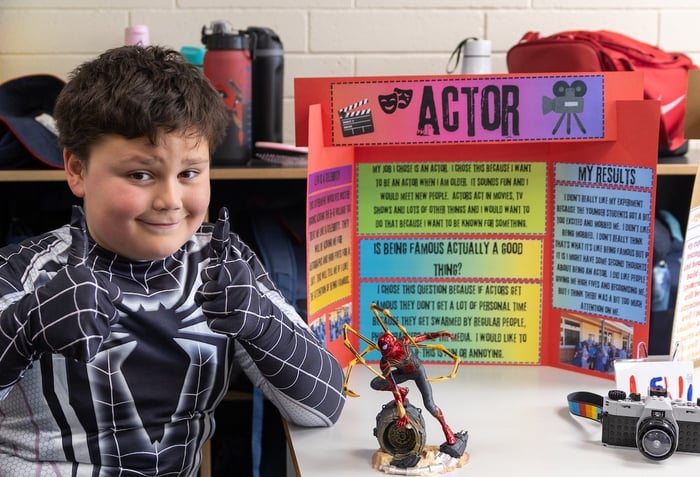
Conclusion: Keep thinking critically about acting as a career aspiration.
Taking a new tack; learning a valuable skill
Reflections like these inspire new angles for thinking about careers: if not this then maybe that? Who else is recognised (but not mobbed)?
Once students have done their project and reflection, it's not uncommon for about half of them to change their career idea. They might refine it, or move to something else completely. They might have come across a career that's new to them, or found a speciality or an occupation related to something they'd heard of before. In this year 5 cohort, 65% say the BECOME program helped them discover new possibilities for their future.
So if they haven't chosen a career, what's the big gain? Skills and self-awareness.
In the BECOME program and Flipped Career ExpoTM, the 'experiment' is personal, scaffolded and structured carefully to expand each student's awareness of careers in the world, AND to develop self-awareness.
They are gaining a useful skill towards career readiness. Next 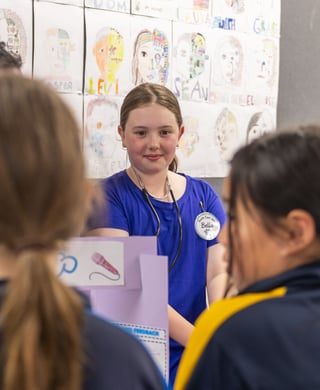 time they examine a career idea, their thinking will be more informed, a bit more considered and mature. Practising this in the safety of school before anyone has to make a decision helps them significantly later.
At the Flipped Careers ExpoTM, students present to an audience of peers, younger students and the community. They're taken seriously in the career ideas they have right now, but there's plenty of time so no-one is pushed to commit.
If it feels like play, it is -- but it's serious play.
Exploration, imagination, personal reflection ... these are all ways the BECOME program helps younger students see what they might be capable of, and build a positive vision for the future.
Engagement and optimism
The final, powerful effects of early, curiosity-driven career exploration are engagement and optimism.
Before the program, a number of students rated the connection between what they were learning at school and what they wanted to do in the future as low (1–3 out of 7). Following the program, there is a 37% reduction in the proportion of students reporting low connection between school and the future. More of the cohort see why school matters!
Even better, 59% of the year 5 cohort are more excited or a lot more excited about their future than before the program, and over 2/3 of them say they feel more confident they can take action on their ideas for the future than before BECOME.
And that is the purpose: a salient vision for the future, that you have made efforts to refine and clarify, with an understanding that you - the young person - will need to take action and invest effort to make it happen.
 How All Teachers Shape Student Futures
Dive into the future as an engine for connection and learner engagement today. Extend existing practice in evidence-informed ways to support positive, motivating student aspirations, gain practical ideas and experience with tools to use immediately in the classroom.
Coming in T1 2027.
 Bev Laing
 Liv Pennie : Jan 23, 2024, 9:08:21 AM